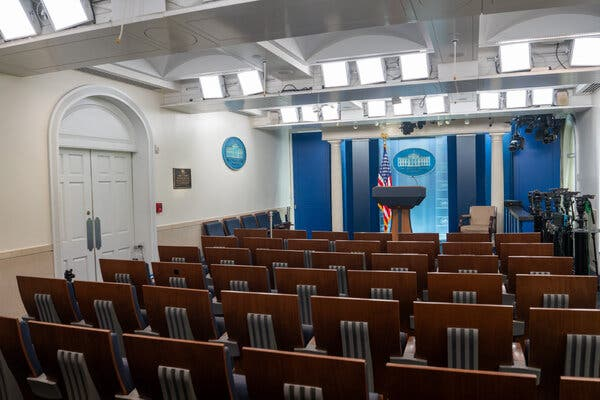
Washington , The U.S. Department of Justice has launched a civil antitrust inquiry into whether the television networks that supply the White House television press pool broke federal competition law when they temporarily halted pooled coverage of the president, the department said.
What the inquiry covers
The Antitrust Division is examining actions by the five major television outlets that traditionally rotate responsibility for capturing and distributing live White House audio and video: ABC, CBS, CNN, NBC and Fox News. A Justice Department spokesperson said members of the television press pool “have proudly boycotted covering White House events,” and that group boycotts among commercial competitors can violate the Sherman Act. The department said it is investigating to determine whether the networks’ coordination crossed that legal line.
How the suspension began
The pool suspension followed the White House decision, in September, to bar three outlets from White House grounds: CNN, the online Politico Washington vertical, and the network MS NOW. Those exclusions prevented CNN from performing its assigned pool duties, prompting the pool chair at the time to notify subscribers that the TV pool would not perform its usual functions when CNN could not participate and that no replacement pool would be established.
Outlets that normally rely on feeds from the pool were left without centrally distributed live footage for several days. Broadcasters said their temporary halt was a show of solidarity and a protest against what they described as arbitrary restrictions on press access. The Justice Department has asked networks for communications and materials related to the decision, according to reporting by major national outlets that first disclosed the inquiry.
Why this matters to Hollywood and media businesses
At first glance, the dispute is a Washington press freedom fight. But it also has direct commercial and operational consequences for television newsrooms and the broader media ecosystem that Hollywood closely follows. Television pools are a cost sharing mechanism with logistical and technical responsibilities, and they underpin how networks capture key footage from presidential events for distribution to news divisions and downstream platforms. An antitrust finding, or even a protracted inquiry, could force networks to change how they co operate in the field, increasing costs and complicating live coverage workflows.
For entertainment and news divisions owned by major media conglomerates, the inquiry injects legal uncertainty into routine newsgathering arrangements. It may prompt corporate legal teams to re evaluate standing protocols for shared operations, and could affect licensing and archival agreements for presidential footage used in documentaries, cable programming and streaming packages.
Free press, antitrust law and the legal questions
The investigation creates a tension between two longstanding principles of U.S. law: the First Amendment protection of a free press, and antitrust statutes that prohibit coordinated commercial boycotts among competitors. Networks and press freedom advocates argue that refusing to perform pool duties was an editorial and professional judgment, not a commercial restraint intended to harm competition.
By contrast, antitrust enforcement looks at coordinated actions among market competitors. Justice Department officials framed the review as a routine assessment to determine whether the circumstances meet the statutory threshold for antitrust liability. The inquiry is civil and investigatory at this stage; it does not automatically mean prosecutors will file a case.
Reactions and possible outcomes
News organisations that depend on pool feeds will be monitoring the inquiry closely and are likely to consult union representatives, newsroom editors and corporate counsel about how to comply with potential document requests. Legal experts say outcomes could range from a limited document review and closure with no enforcement action, to settlement talks over new protocols, or rarely, a civil enforcement action if investigators find credible evidence of unlawful coordination for commercial advantage.
Beyond legal exposure, the probe is drawing criticism from press freedom advocates who say using antitrust tools against journalistic cooperation may chill collective responses to executive actions perceived as threats to reporting independence. Those concerns add to existing industry debates about government pressure on newsrooms, access to official events, and how television news operations balance commercial and editorial imperatives.
What readers should watch next
- Whether the Justice Department requests formal testimonies or issues subpoenas to participating networks, which would signal a deeper enforcement stance.
- Any public statements by the networks named in the inquiry, including whether they change pool procedures or establish alternative arrangements to ensure coverage continuity.
- Court filings from the outlets that were barred from the White House, and whether those parallel First Amendment litigation developments affect how the antitrust inquiry proceeds.
The Justice Department framed its announcement as an investigative step to determine whether antitrust laws were implicated by the pool suspension. The inquiry positions a routine newsroom cooperation mechanism at the center of broader arguments about press independence, government power and the commercial rules that govern how major media companies operate, a subject of immediate relevance to television newsrooms and Hollywood companies with news divisions and archival businesses.