Greek police announced on October 9 and October 10 they have dismantled two organized criminal groups that carried out systematic illegal excavations and trafficking of antiquities across northern Greece. The operations, led by the Hellenic Police Organized Crime unit in the north, resulted in 11 arrests and the seizure of archaeological finds, specialized detection equipment and weapons. Officials said the networks had been active since at least September 2025 and targeted sites across six prefectures.
How the investigation unfolded
The Hellenic Police said the case followed a prolonged inquiry by the Office for the Protection of Cultural Heritage and Antiquities within the unit tasked with combating organized crime. Investigators used information gathering, targeted surveillance and specific investigative acts to map each group s structure and the roles of its members.
Authorities executed a wide scale operation on October 8, concentrating on counties in northern Greece, and brought charges against 11 suspects. Police described the detained individuals as 10 Greek nationals and one foreign national, and said the leadership of both organizations included experienced operators, one of whom is an active duty military service member.
What police seized
During searches and arrests the police recovered a range of material that investigators say shows a high level of technical capability and planning. Confiscated items include numerous metal detectors and ground scanning devices, 24 detectors reported in one account, geophysical survey equipment, pickaxes, power drills, generators, drones, and three cars used to reach remote excavation sites.
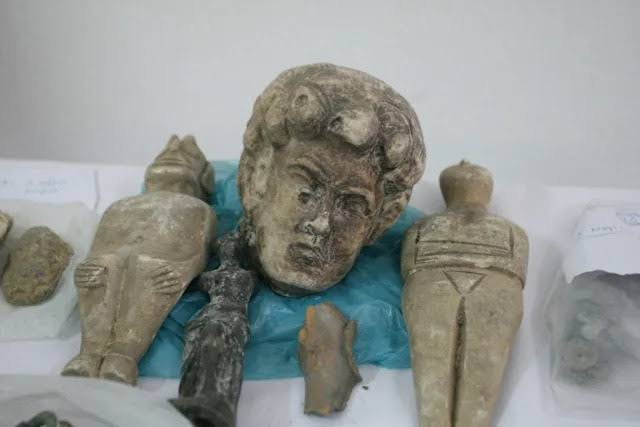
Police also seized a collection of archaeological material and coinage, including bronze figurines and marble architectural fragments, along with many ancient coins. Officials listed three hunting rifles, an air pistol, three gold sovereigns, 875 Turkish lira and 11,130 euros in cash among the items taken during searches. The recovered antiquities have been transferred to the Thessaloniki Antiquities Ephorate for cataloguing and further forensic examination.
Modus operandi and evidence of organization
Investigators concluded both groups worked in similar ways. They recruited or relied on local contacts to locate areas of archaeological interest and used sophisticated detection tools to survey terrain before digging. The groups employed four wheel drive vehicles to access isolated sites and used hand tools and small mechanical equipment when they excavated.
Police said the organizations also used coded language to conceal communications. Recorded or documented code words included references where a "job" or "jogging" denoted a dig, "exercise equipment" referred to detectors, "coin" meant an ancient coin, "whites" were well preserved precious metal coins, and a "miracle" indicated a particularly valuable find. One group reportedly kept an archive of potentially fruitful locations, compiled from old documents and maps, which guided their targeting.
Leadership roles and alleged markets
The official account indicates different functions inside the two networks. One alleged leader coordinated reconnaissance and logistics, appraised finds and arranged sales abroad. The other alleged leader, the serving military member, concentrated operations in the Evros area, according to police statements.
Police say that in some cases the networks sought out people who already possessed items of archaeological interest and offered to buy them, while in other cases they undertook illicit excavations to obtain material to move into illicit markets. The case file will be passed to prosecutors and the suspects will appear before examining magistrates.
Context and significance
Greece s cultural heritage is exceptionally rich and vulnerable. Illegal digging and illicit export of antiquities not only deprives local communities and the public of archaeological context, but also destroys information that cannot be recovered once a site has been looted. Authorities framed the arrests as part of an ongoing effort to protect cultural property and to dismantle criminal networks that monetize heritage.
The crackdown comes after earlier operations earlier in 2026 that targeted similar rings. Officials highlighted that the current arrests follow months of investigation and represent the continuation of a pattern of law enforcement efforts to disrupt the supply chain behind illegal antiquities trade.
What happens now
The recovered items have been delivered to the regional antiquities authority for assessment. Forensic analysis, cataloguing and provenance work will determine whether additional charges or international recovery steps are needed. Prosecutors will consider charges that include operating a criminal organization, repeated aggravated theft of cultural property, damage to property and violations of the antiquities protection law and weapons legislation.
Police said their investigation remains open. Authorities also stressed cooperation with regional antiquities services and the intention to pursue any international links that would facilitate illicit exports.
For now the arrests underscore how criminal groups continue to exploit Greece s archaeological wealth, and they signal renewed enforcement efforts combining cultural heritage specialists and organized crime investigators to protect sites and intercept trafficked objects.