akistan’s political confrontation intensified on Tuesday as Pakistan Tehreek-e-Insaf continued its long march through Khyber Pakhtunkhwa while Prime Minister Shehbaz Sharif offered a new path to negotiations — but only if the opposition ends its protest campaign first.
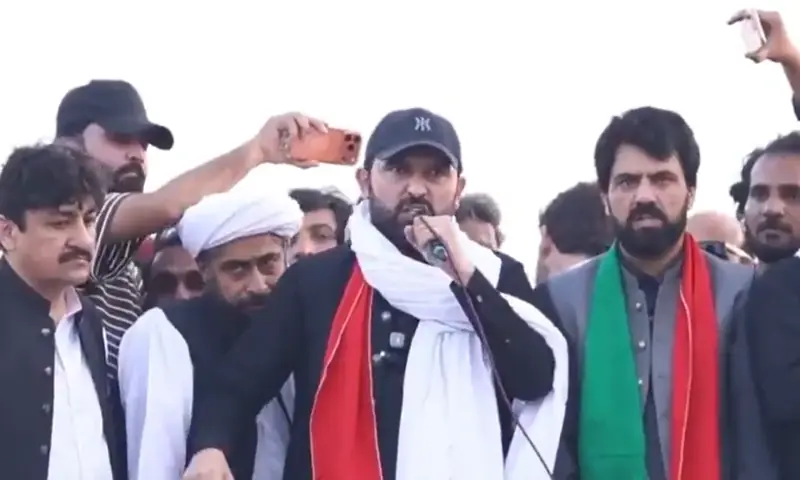
Led by Khyber Pakhtunkhwa Chief Minister Sohail Afridi, the PTI mobilisation has been progressing through the province after beginning from Lakki Marwat on October 4. The convoy reached the Kohat area before continuing toward Mattani on the outskirts of Peshawar, with October 8 emerging as a potentially decisive point in the protest.
The march comes after negotiations between PTI and representatives of the federal government and Pakistan Peoples Party failed to produce an agreement.
PTI has linked its protest to several disputes with the federal government, including demands surrounding jailed former prime minister Imran Khan and disagreements over security and counterterrorism policy in Khyber Pakhtunkhwa.
The federal government, meanwhile, has warned against bringing the protest into Islamabad and says political disagreements should be settled through dialogue rather than prolonged street mobilisation.
With neither side currently accepting the other’s conditions, Pakistan is entering another period of political uncertainty.
Shehbaz Sharif Offers Talks — But Wants the March Ended First
Prime Minister Shehbaz Sharif made a fresh public offer of negotiations on Tuesday, calling on PTI to abandon the march and return to political dialogue.
The offer, however, comes with a clear condition.
The government wants the march and any planned sit-in to end before formal negotiations resume.
Speaking in Islamabad, Shehbaz argued that repeated protest movements could damage economic activity at a time when the government says Pakistan is moving toward greater macroeconomic stability.
His position creates a difficult political equation.
PTI launched the march partly because negotiations failed. The government is now saying negotiations can resume if PTI stops the very protest it began after those talks broke down.
Unless one side changes its position, that disagreement could prevent an immediate return to the negotiating table.
Government representatives say previous discussions were conducted seriously and accuse the opposition of preventing a final agreement.
PTI disputes that interpretation and argues that meaningful progress was not made on issues it considers fundamental.
Those competing accounts mean the collapse of negotiations has itself become part of the political confrontation.
PTI March Continues Through Khyber Pakhtunkhwa
The march began from Lakki Marwat on Sunday under the leadership of Chief Minister Sohail Afridi.
Rather than attempting to move immediately toward Islamabad in a single push, PTI has adopted a staged mobilisation through different areas of Khyber Pakhtunkhwa.
The convoy travelled through Karak and reached Kohat, where supporters gathered as Afridi addressed participants.
On Tuesday, the march was scheduled to continue toward Mattani near Peshawar.
The gradual movement appears designed to maintain mobilisation while allowing additional supporters to join at different stages.
Afridi has described the campaign as a sustained political struggle rather than a short protest.
That distinction is important because it leaves PTI with several strategic options.
The party could eventually move toward Islamabad, increase pressure through demonstrations inside Khyber Pakhtunkhwa, reopen negotiations or announce another form of protest.
For now, PTI has not completed the final stage toward the federal capital.
October 8 Could Become the Key Date
One of the most important moments is expected on Thursday, October 8.
PTI has said its next major decision will be taken after the convoy reaches Khairabad, close to the boundary between Khyber Pakhtunkhwa and Punjab.
That makes Khairabad more than another stop on the route.
It could become the location where PTI determines whether the movement proceeds toward Punjab and eventually Islamabad or shifts to a different strategy.
Afridi has already used cricket imagery to describe the next stage, suggesting that the movement will become more intense from October 8.
Until the party formally announces its next move, however, claims that the march will definitely enter Islamabad should be treated cautiously.
The current confirmed development is that PTI is continuing its mobilisation through Khyber Pakhtunkhwa and intends to make an important strategic decision after reaching Khairabad.
Government Warns March May Not Move Beyond Attock
Pressure is also building around Attock, the critical gateway between Khyber Pakhtunkhwa and Punjab for protesters travelling toward Islamabad.
Khyber Pakhtunkhwa Governor Faisal Karim Kundi said on Tuesday that the PTI march would not be allowed to proceed beyond Attock.
His statement raises the possibility of a confrontation if PTI ultimately orders supporters to continue toward Punjab.
Kundi has also questioned the scale of PTI’s mobilisation and criticised the provincial government for concentrating on political protests while Khyber Pakhtunkhwa faces serious security challenges.
PTI rejects the argument that its political mobilisation ignores security concerns.
Afridi has instead criticised the federal approach to counterterrorism and says the province needs a different strategy to establish lasting peace.
The disagreement over security policy is therefore not separate from the march. It is one of the issues contributing to the broader dispute between the PTI-led provincial administration and the federal government.
Imran Khan Remains at the Centre of the Protest
Although Imran Khan is not physically leading the march, his imprisonment remains central to PTI’s mobilisation.
The former prime minister has been imprisoned since 2023 and faces multiple legal cases.
PTI argues that the cases against its founder are politically motivated. Pakistani authorities reject that characterisation and maintain that legal proceedings are being handled through the country’s judicial system.
Supporters participating in the march are demanding his release, while PTI leaders have also raised concerns about access to Khan by his family, doctors, lawyers and political representatives.
PTI chairman Gohar Ali Khan said Tuesday that party leaders had not been receiving the access they were seeking.
The government has disputed broader PTI claims concerning Khan’s treatment and health.
These competing statements need to remain clearly separated.
PTI has expressed concern about Khan’s condition and access to him. Government officials maintain that he is receiving appropriate treatment and that prison meetings cannot be used for political purposes.
No unverified claim about Khan’s health should be presented as an established medical fact without confirmation from an authoritative medical source.
Why Previous Negotiations Failed
Before the march began, representatives from PTI, the government and PPP held multiple rounds of discussions aimed at preventing another major confrontation.
Those negotiations ultimately failed.
Both sides have blamed each other.
Government officials argue that PTI changed or expanded its position during negotiations, making a final agreement impossible.
PTI maintains that its core concerns were not adequately addressed.
Afridi has publicly referred to a draft containing PTI’s demands and challenged the government to identify which of them it considers unconstitutional or unlawful.
The disagreement illustrates a broader problem in Pakistan’s political environment.
Dialogue is taking place, but the parties remain deeply divided over the conditions necessary for compromise.
The new offer from Shehbaz means negotiations are not completely off the table.
But the sequence matters.
The government says: stop protesting, then negotiate.
PTI’s decision to continue marching indicates that it is not yet prepared to accept that formula.
Islamabad Becomes the Bigger Question
Whether the march ultimately reaches Islamabad remains uncertain.
The federal government has made clear that it does not intend to permit a major protest gathering in the capital.
That position means the political temperature could rise significantly if PTI announces from Khairabad that supporters should continue toward Islamabad.
Previous PTI demonstrations have resulted in confrontations between protesters and security personnel, making both sides’ decisions particularly important.
A peaceful outcome would likely require either renewed negotiations or an arrangement governing where and how supporters can demonstrate.
Without such an agreement, road closures, security deployments and attempts to restrict movement could create further tension.
The next stage therefore carries consequences beyond party politics.
Transport, businesses, schools and ordinary commuters can all be affected when major routes between Khyber Pakhtunkhwa, Punjab and Islamabad are disrupted.
Counterterrorism Dispute Adds Another Layer
One of the less straightforward elements of the current confrontation is the disagreement over counterterrorism strategy.
Khyber Pakhtunkhwa has faced persistent militant violence, and the security situation has become part of the dispute between provincial and federal authorities.
Afridi argues that existing approaches have failed to establish sustainable peace in the province and says his administration wants an alternative strategy.
Federal officials have criticised PTI’s approach and questioned whether organising a large political march is appropriate while the province faces serious security threats.
That debate gives the current protest a different dimension from a movement focused exclusively on Imran Khan.
It involves questions about provincial authority, federal policy and how Pakistan should respond to militancy in one of its most security-sensitive regions.
Pakistan Faces Another Test of Political Dialogue
Pakistan has experienced repeated periods of political confrontation since Imran Khan was removed from office through a parliamentary no-confidence vote in April 2022.
The current march demonstrates that the underlying political conflict remains unresolved.
PTI continues to command substantial support and retains control of the Khyber Pakhtunkhwa provincial government.
Shehbaz Sharif’s federal government, meanwhile, argues that stability and economic recovery should take priority over disruptive street protests.
Both sides therefore present their positions as being in the national interest.
The challenge is finding a mechanism through which those competing claims can be resolved without another damaging confrontation.
For the government, reopening talks without PTI ending the march could appear to reward political pressure.
For PTI, ending the march before receiving meaningful concessions could weaken the leverage created by its mobilisation.
That is why the current standoff is difficult to resolve.
What Happens Next?
The next 48 hours could provide a clearer indication of where the movement is heading.
The first major point to watch is the progress of the convoy through Peshawar and toward Khairabad.
The second is whether PTI formally announces an onward movement toward Attock, Punjab and Islamabad after October 8.
The third is whether either side modifies its conditions for negotiations.
A renewed dialogue could reduce tensions quickly.
A decision to continue toward Islamabad despite government warnings would create a much more serious test for both political leaders and security authorities.
For now, Pakistan remains between those two possibilities.
The march continues.
The government is offering talks, but only after the protest ends.
PTI has not accepted that condition.
And with the convoy moving closer to the boundary between Khyber Pakhtunkhwa and Punjab, the most consequential stage of the political confrontation may still be ahead.