Spanish authorities dismantle 'Vatoil-Visco' fuel fraud ring, seize 86,000 litres and freeze more than 60 bank accounts
The Guardia Civil and Spain’s Tax Agency arrested six people and placed eight under investigation in an operation that authorities say evaded more than 2 million euros in taxes through undeclared fuel sales across Murcia, Alicante and other provinces.
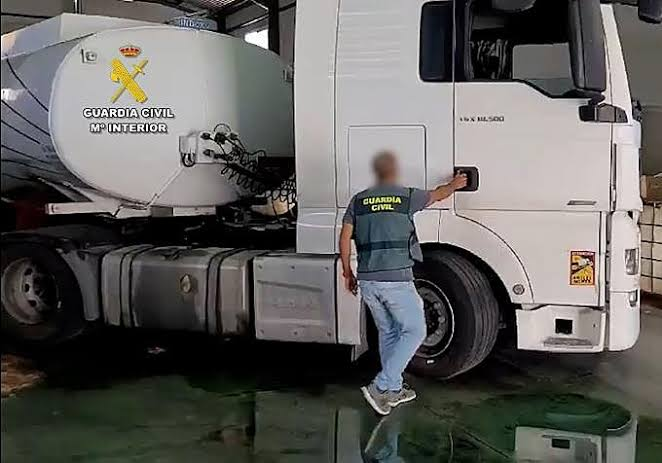
Madrid, October 1, 2026 H2: Large scale fuel tax fraud uncovered in Murcia-led operation Spanish law enforcement on Thursday announced the dismantling of an organized criminal network accused of selling and distributing fuel outside of fiscal controls, in an operation led by the Guardia Civil and the Agencia Estatal de Administración Tributaria. Authorities said the probe, conducted under the operational name Vatoil-Visco, resulted in six arrests, eight people placed under investigation and preventive measures that include the sealing of three fuel storage tanks containing about 86,000 litres of fuel. The authorities described the group as a structure of companies and individuals based in the Murcia region that operated fuel distribution nodes in Murcia, Alicante and other provinces. Investigators say the ring used a web of commercial entities to market and move fuel without declaring the taxes and special duties that apply to hydrocarbon sales, depriving the public treasury of revenue. H2: Scope of the alleged evasion and operational measures Officials put the estimated loss to public finances at more than 2 million euros for a single year of operations. Investigators focused the operational phase of the inquiry on sites identified through financial and commercial analysis, carrying out simultaneous searches that led to the seizure of three storage installations and the closure of fuel dispensers at three service stations. Agents also impounded five high end vehicles and recovered cash and documentation related to the scheme. Authorities said more than 60 bank accounts tied to the network were blocked as part of immediate asset preservation actions. The Guardia Civil and the Tax Agency said the account seizures and the administrative measures are intended to prevent dissipation of funds while judicial authorities consider charges that include belonging to a criminal organization, tax offences, consumer crimes, document falsification, fraud and money laundering. H2: How the alleged scheme worked According to the investigators summary, the network relied on a pattern commonly seen in fuel VAT and excise fraud. Companies in the chain sold fuel without properly declaring or applying the relevant special hydrocarbon duties and value added tax. The structure is said to have employed at least two corporate fronts whose business documentation and transaction flows masked the real movement of product. Investigators say the model produced rapid turnover and enabled the suspects to under-declare tax liabilities while continuing customer-facing fuel sales through retail outlets. The operation combined commercial analysis with traditional policing. Financial investigators monitored anomalous transactional flows in a cluster of companies, which prompted targeted inspections and then the simultaneous search and seizure measures that produced both physical and documentary evidence and the account freezes. H2: Regional footprint and wider enforcement context Most of the operational activity took place in Murcia and Alicante, but the inquiry led to measures in other provinces, including the sealing of a deposit and a fuel dispenser in Ciudad Real. The case is the latest in a sequence of Spanish enforcement actions targeting fraud in the hydrocarbons market, a sector that has been subject to repeated attempts to exploit complex tax and distribution systems for illicit profit. Authorities highlighted that sophisticated VAT and excise fraud in fuel distribution can cause heavy revenue losses and distort competition within the sector, while also creating incentives for other criminal enterprises to use fuel distribution chains for money laundering. H2: Legal process and next steps Those arrested have been presented before the competent examining court for formal charges. One detainee remained in custody at the time of the announcement, while the remainder were released with precautionary measures. The investigation file has been forwarded to the relevant court and prosecutors who will determine formal indictments based on the evidence collected during the searches and financial inquiries. The Tax Agency said the action was taken by its Service of Customs and Special Taxes, in cooperation with the Guardia Civil provincial judicial units, and emphasised that blocking accounts and sealing storage prevents the immediate dissipation of assets that could frustrate recovery of evaded public funds. H2: Why this matters Fuel excise and VAT fraud can erode significant tax revenues and shift the competitive environment in a sector that relies on regulated taxation to ensure safety, pricing transparency and public income. The operation shows Spanish fiscal authorities continuing to prioritise investigations that combine forensic accounting, cross agency cooperation and targeted on the ground enforcement to interrupt complex commercial frauds. For consumers and legitimate operators, recent enforcement signals that regulators are intensifying efforts to protect the market. For law enforcement, the case illustrates the use of financial intelligence and interagency coordination to unmask corporate and logistics arrangements used to conceal the true economic activity behind sales of regulated products. As the judicial phase proceeds, prosecutors will decide whether to bring formal charges and seek asset confiscation to recover tax losses. The Guardia Civil and the Tax Agency said they will continue to pursue leads that might expose wider links or further participants in the alleged network.
Topics
LocationMurcia, Alicante, Ciudad Real