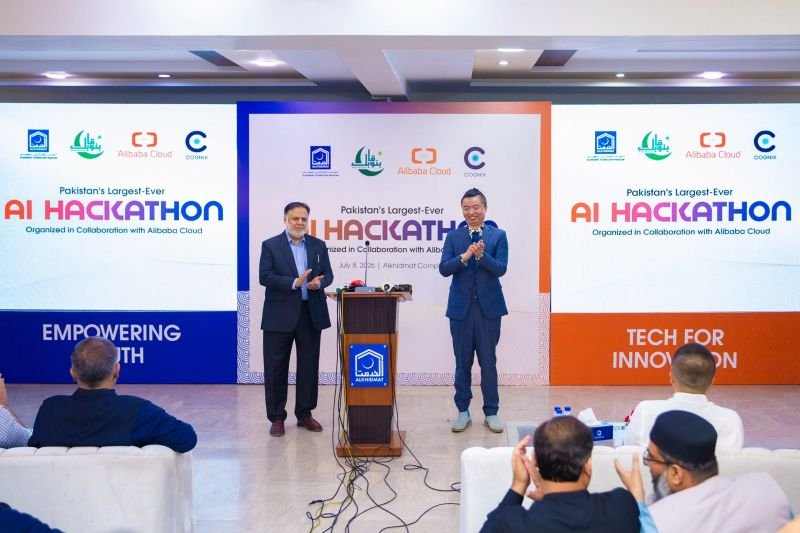
Karachi became the first city to host regional technical evaluations for the Alibaba Cloud AI Hackathon Pakistan 2026 on Saturday October 3, as teams from across Sindh and neighbouring provinces presented working artificial intelligence prototypes to judges and mentors. Organised locally by the Alkhidmat Foundation’s Bano Qabil programme with operational support from Cognix Solutions and technical backing from Alibaba Cloud, the event is framed as a national pipeline for turning student projects and early stage ideas into products that can address Pakistan’s public and commercial problems.
What is happening in Karachi
The regional round ran at the NASTP Karachi campus on Main Shahrah e Faisal, with participants scheduled to present their entries at daylong evaluation sessions. According to the hackathon portal and organiser announcements, presentations cover a wide range of use cases, including agri tech, health tech, education, fintech and public services, each built using Alibaba Cloud AI tools and credits provided to competitors. Teams that clear regional technical review will move on to national finalist preparation and mentorship phases, with organisers signalling further regional dates for Lahore and Islamabad.
Why the event matters for Pakistan’s AI ecosystem
The Karachi regional round is not just a student competition. It sits inside a wider national push by government and private actors to cultivate domestic AI capability. Over the last 18 months Pakistan has published a National AI Policy, established an Islamabad AI Declaration and announced funding and institutional efforts to build data governance, training pipelines and sovereign capability. Bringing a global cloud provider, a major local training charity, and national partners together creates a practical bridge between policy commitments and on the ground skills, helping promising teams access cloud infrastructure, mentorship and potential investor visibility.
For an ecosystem that has repeatedly identified follow on funding and commercialization as choke points, an organised event of this scale helps surface investable teams earlier, while exposing founders to tooling and architectures they will need to scale. For students and developers, working with a major cloud vendor’s AI stack shortens the learning curve for deploying models in production and demonstrates approaches to cost control, data handling, and system design that are critical to building real world solutions.
Landscape and partnerships behind the hackathon
The hackathon is the product of a public private partnership model that Pakistan has been accelerating. Alkhidmat Foundation’s Bano Qabil initiative focuses on nationwide skills training and is serving as the local delivery partner. Cognix Solutions is providing the technical operations backbone and event management. Alibaba Cloud is contributing cloud credits, tooling and mentorship, framed as part of its broader investment in developer ecosystems across emerging markets. Local media and industry outlets covered the hackathon launch earlier this year, and social posts from participating teams and organisers in the days before the regional round confirmed event logistics and participant preparation.
Early signals from participants and organisers
Linked social updates from organisers and multiple teams in the run up to the Karachi round reflect strong grassroots interest and a pragmatic focus on solving local problems. Participant posts emphasised iterative development, real life testing, and readiness to pivot when models or user flows failed during development. Organisers emphasised identity verification for attendees and compliance with regional venue processes, reflecting a formalised approach to event governance.
What to watch next
Attention now turns to the quality of solutions that emerge from the regional technical reviews, whether the strongest projects attract mentorship or investment offers, and how organisers manage the transition from prototype to scale. Key milestones include the announcement of national finalists, the availability of follow on support from national incubators and funds, and any commitments by government or private investors to pilot winning projects in public services or commercial deployments. Observers will also be watching for signals that the hackathon can produce repeatable pipelines for talent into incubators, industry roles, and exports.
Why this matters beyond a single event
Pakistan is balancing two simultaneous ambitions. The first is to accelerate digital job creation through training and competitions that convert skills into paid opportunities. The second is to cultivate sovereign capacity and governance around AI so that the country can adopt models and systems in ways that are aligned with national priorities and data protection frameworks. Events that combine global tooling with local delivery help bridge those ambitions by offering hands on experience with the same cloud stacks used in many production systems, while keeping project design oriented to Pakistan specific challenges.
The Karachi regional round of the Alibaba Cloud AI Hackathon Pakistan 2026 therefore functions as more than a single day of pitches. It is an operational test of the collaborative model Pakistan has been building between civil society, cloud providers, startups and government. If it produces several viable finalists that attract post hackathon support, it will strengthen an argument for sustained investment in training to product pipelines over the coming years.
Organisers said regional technical evaluations will continue to feed national finalist selection and further mentorship. Stakeholders in government and industry are expected to monitor progress as the competition advances, looking for projects that can move quickly from prototype to pilot deployment in agriculture, education and health services where practical, measurable impact can be demonstrated within months.