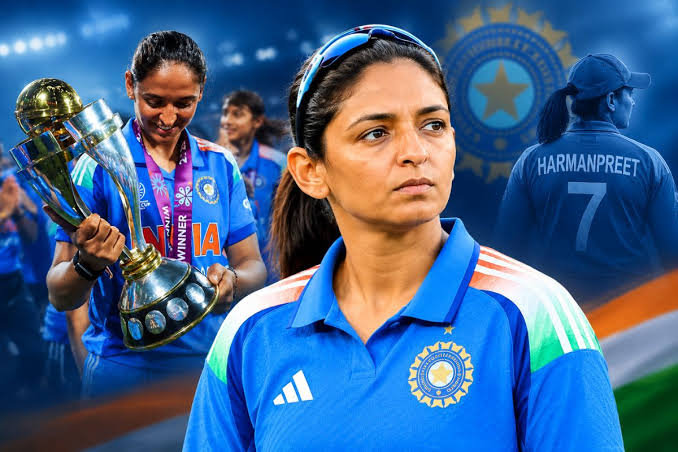
Harmanpreet Kaur has stepped away from the captaincy of India’s women’s cricket team across all formats, bringing an extraordinary leadership era to a close while choosing to continue her international career as a player.
The announcement on October 6, 2026 represents a major turning point for Indian cricket. Kaur has been one of the defining figures in the rise of the women’s national team, leading India through years in which expectations, visibility and competitive standards increased dramatically.
Her departure from the captaincy comes from a position of considerable achievement. India won its first Women’s ODI World Cup under her leadership in 2025 and followed that success with another Asian Games gold medal in 2026.
Now, at 37, Kaur is handing responsibility to a new leader rather than leaving international cricket altogether.
That distinction makes the transition particularly significant. India is not immediately losing one of its most experienced players. Instead, the team has an opportunity to introduce a new captain while keeping Kaur’s knowledge, batting ability and experience within the squad.
A Leadership Era Comes to an End
Kaur’s association with the Indian captaincy stretches back more than a decade.
Her first opportunity to lead India arrived unexpectedly in 2012, when she captained the team in the Women’s T20 Asia Cup final because senior players Mithali Raj and Jhulan Goswami were unavailable.
India defeated Pakistan by 18 runs in that final, giving a young Kaur an early taste of leadership on an important stage.
The temporary responsibility eventually became something much bigger.
She became India’s regular T20I captain in 2016 before taking responsibility for the ODI and Test teams following Mithali Raj’s retirement in 2022.
By the time she stepped down, Kaur had captained India in five Tests, 51 ODIs and 155 T20 internationals.
Those numbers demonstrate the length of her tenure, but they only tell part of the story.
Her years as captain coincided with one of the most important periods in the development of women’s cricket in India.
From Contenders to World Champions
For years, India possessed enough talent to challenge the strongest teams in women’s cricket.
What remained missing was the biggest global trophy.
There were promising campaigns and painful defeats. India reached the final of the 2020 Women’s T20 World Cup and took silver at the 2022 Commonwealth Games. Those performances showed that the team could compete at the highest level, but they also increased the pressure to convert progress into a major championship.
That breakthrough finally arrived in 2025.
Playing a home World Cup brought enormous expectations, but India managed to turn that pressure into a historic campaign.
One of the defining moments came in the semi-final against Australia.
Chasing 339, India completed a record pursuit to reach the final. Kaur contributed 89 and combined with Jemimah Rodrigues in a 167-run partnership that changed the direction of the match.
India then faced South Africa in the final in Navi Mumbai.
A 52-run victory delivered the trophy that had remained beyond India’s reach for decades.
For the first time, India were Women’s ODI World Cup champions.
And Harmanpreet Kaur was the captain who lifted the trophy.
Why the 2025 World Cup Changed Her Legacy
Winning a World Cup creates a dividing line in sporting history.
Before 2025, Kaur could already be regarded as one of the most influential players produced by Indian women’s cricket. After the tournament, her position in that history became even stronger.
The championship represented more than one successful month of cricket.
It was the result of years of increasing professionalism, improved depth, difficult tournament experiences and growing belief that India could challenge established powers consistently.
Kaur had experienced much of that journey herself.
Her unforgettable unbeaten 171 against Australia in the 2017 World Cup semi-final had already demonstrated her ability to dominate a major match. That innings helped India reach the final and introduced her destructive batting to a much wider audience.
Eight years later, she was no longer simply producing a spectacular individual performance.
She was leading the entire team to the title.
That progression — from match-winner to World Cup-winning captain — captures much of her significance to Indian cricket.
Success Continued After the World Cup
The World Cup could easily have provided a natural finishing point for Kaur’s captaincy.
Instead, another major success followed.
India secured a second consecutive Asian Games women’s cricket gold medal in 2026, defeating Sri Lanka by 147 runs in the final in Nagoya.
It became Kaur’s final assignment as India captain.
That means her leadership tenure ends not during a period of collapse, but after major trophies in consecutive years.
Such timing gives India an opportunity to approach succession strategically.
A new captain will not be asked to repair a team without direction. She will inherit a squad accustomed to competing for championships.
The challenge will be maintaining that standard.
Indian Women’s Cricket Is Now Operating Under Different Expectations
One of the most important parts of Kaur’s legacy is the change in what Indian supporters expect from the women’s national team.
There was a period when reaching the latter stages of a global tournament could itself be viewed as an important achievement.
That standard has changed.
India now enter major competitions with genuine expectations of winning.
Players are increasingly recognised nationally. Domestic opportunities have expanded. Matches receive greater attention, and performances are analysed with the intensity that accompanies elite sport.
Success brings benefits, but it also creates pressure.
The next captain will operate in an environment where a semi-final appearance may no longer automatically be considered enough.
That is one consequence of the progress achieved during Kaur’s era.
She leaves behind a stronger team, but also a higher benchmark.
India Now Faces an Important Captaincy Decision
Attention will quickly turn to who should lead India next.
Smriti Mandhana is widely viewed as a leading candidate and has considerable international experience, but the final leadership structure will be for the selectors and BCCI to determine.
India also has a broader strategic decision to make.
The selectors could appoint one captain for Tests, ODIs and T20Is, maintaining a unified leadership structure. Alternatively, responsibilities could eventually be divided between formats as the international calendar becomes increasingly demanding.
Whichever approach India chooses, the new captain will inherit something valuable: Kaur intends to remain part of the team.
That could make the transition considerably smoother.
Former captains possess knowledge that cannot easily be recreated through coaching manuals or tactical meetings. They understand the emotional pressure of major tournaments, the difficulty of making decisions when a match turns suddenly, and the scrutiny that follows defeat.
If managed correctly, Kaur can provide that experience without interfering with the authority of her successor.
Stepping Down Could Also Help Kaur the Batter
There is another dimension to the decision.
Captaincy consumes energy.
A captain must think about team selection, tactics, bowling changes, field placements, individual players and match situations while still being expected to perform personally.
Removing those responsibilities could allow Kaur to concentrate more fully on her batting.
At 37, workload management becomes increasingly important, but experience can also make a senior batter extremely valuable in high-pressure situations.
India may therefore still benefit significantly from Kaur even after the captaincy transition.
Rather than viewing the announcement purely as something India has lost, it can also be understood as a change in how one of the country’s most experienced cricketers contributes.
Her next challenge will be simpler in definition, even if it remains difficult in execution: score runs, win matches and support the players around her.
Her Influence Goes Beyond the Scorecard
Cricket statistics will preserve Kaur’s runs, appearances, victories and trophies.
Her broader impact is more difficult to quantify.
She has played through a transformation in women’s cricket.
The environment surrounding the Indian women’s team today is substantially different from the one she entered as a young international cricketer. The audience is larger, the commercial opportunities are greater and the pathway for young players is more visible.
Kaur did not create that transformation alone.
Generations of Indian players contributed to it, including those who built the foundation before her.
But she became one of the most recognisable faces of the period in which women’s cricket moved further into India’s sporting mainstream.
That matters because sporting influence is not measured only by trophies.
It can also be measured by what the next generation believes is possible.
A New Chapter for Harmanpreet and India
Kaur’s decision creates two new stories at the same time.
For India, the search begins for a captain capable of taking a world championship-winning team into its next era.
For Kaur, a different stage of her career begins.
She no longer has to carry the formal responsibility of leading the national side, but she still has an opportunity to influence its future.
Her experience can help younger players. Her batting can still change matches. Her understanding of pressure can remain valuable when India enter another major tournament.
Eventually, every captain has to hand over the role.
The most successful ones leave behind more than statistics.
They leave a team capable of moving forward without them.
That may ultimately be one of the strongest ways to judge Harmanpreet Kaur’s captaincy.
She took charge during a period when India were trying to establish themselves consistently among the world’s strongest teams.
She leaves the position after India became world champions.
The armband changes hands now.
The expectations she helped create will remain.