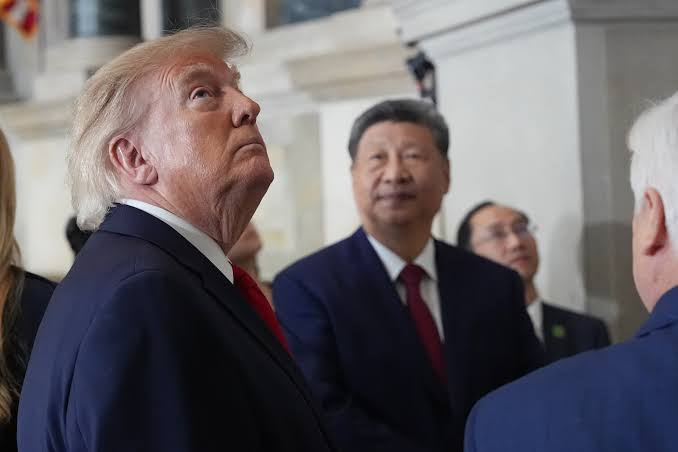
Beijing on Saturday confirmed that China and the United States have agreed to establish a bilateral communication channel for artificial intelligence incidents and to launch a regular China U.S. AI dialogue. The announcement, issued by Chinese diplomatic authorities following President Xi Jinping’s state visit to Washington, casts the move as a pragmatic step to manage cross border risks from rapidly advancing AI systems while preserving each side’s sovereignty over technology governance.
What Beijing officially said
Chinese government statements published after the state visit say the two countries reached an eight point set of understandings, including a commitment to "establish a communication channel for AI incidents" and to convene an AI dialogue to exchange views on risks and benefits. The Chinese Foreign Ministry indicated the next formal exchange will take place in November 2026, and reiterated Beijing’s position that AI must remain under human control and be developed with "people first" values.
The wording in Chinese state briefings stressed reciprocity, mutual respect, and practical cooperation. Domestic outlets and multiple mission websites reproduced the language used in the official readout of the summit, noting the channel is meant to allow the two governments to notify and consult on AI related events that could have cross border security or safety implications.
Why Beijing frames the move as pragmatic
For Chinese authorities, the tone of the announcement aligns with two priorities. The first is to reduce the risk that AI driven accidents, misattribution, or malicious use could escalate into diplomatic or military confrontation. Chinese sources emphasize that an operational contact line would provide a mechanism for rapid clarification when novel incidents occur.
The second priority is to preserve policy space. Beijing’s official messaging links the channel to broader dialogue on the risk and reward trade offs of AI, rather than to binding oversight or joint standards. That framing supports China’s existing approach of coupling strong domestic rules on AI generated content, data protection and platform accountability with selective international engagement.
How the announcement fits China’s recent AI policy trajectory
The new channel follows a string of domestic measures Beijing has rolled out to govern generative AI and related technologies. Chinese regulators have required explicit labelling of AI generated content, strengthened intellectual property rules for algorithms and AI outputs, and undertaken enforcement campaigns against unlawful synthetic content. Those measures reflect a regulatory environment that increasingly emphasizes control, traceability and national security considerations alongside industrial development.
By agreeing to a communication mechanism with the United States, Beijing can signal willingness to manage acute cross border risks while continuing to shape the global governance agenda on terms that protect sensitive data flows and core technological capabilities.
What the channel could look like, and the limits
The public readouts do not include operational details. Important questions remain unanswered, including which agencies will operate the channel, how quickly notifications will be exchanged, whether private sector actors will be allowed to notify across borders, and how incidents will be classified. Analysts caution that a channel is a tool for crisis management, not a substitute for deeper norms, verification regimes or technical standards.
Experts also note potential frictions. Beijing has tightened rules that restrict certain cross border audits and data handling for AI systems. Those domestic constraints could complicate rapid technical cooperation in incidents that require forensic analysis across jurisdictions.
Chinese and international reaction
Within China, state and diplomatic outlets portrayed the agreement as a sensible, stabilizing outcome of the state visit. Outside commentators described the channel as a modest but meaningful confidence building measure that stops short of a comprehensive safety pact. Commentators also flagged the disparity between agreeing to communicate about incidents and agreeing on shared thresholds or joint responses to advanced AI capabilities.
Some technology firms and researchers welcomed a formal line of contact, saying it could reduce the chance of misunderstanding when fast moving AI systems generate unexpected outcomes. Others warned that without agreed definitions and technical protocols, the channel could be limited to diplomatic messaging rather than rapid operational coordination.
Next steps and why it matters
Officials said a China U.S. AI dialogue will begin in November 2026. In practice, the coming sessions will test whether the two sides can convert high level goodwill into practical mechanisms that manage risk without stifling innovation or undermining national security concerns.
For Chinese technology firms and regulators, the channel could offer a structured way to raise or receive alerts about cross border misuse, but it will not change the fundamental constraints of China’s domestic regulatory regime. Internationally, the channel is important because it creates a routine, institutional pathway for governments to discuss emergent incidents from powerful AI systems, reducing the chance that erroneous attribution or accident leads to escalation.
Ultimately, the success of the channel will depend on technical protocols, timetables for information sharing, and whether both sides can agree to operational definitions for what constitutes an AI incident requiring urgent bilateral consultation. The November dialogue will be the first opportunity to see how concrete those next steps become.